

Red is a colour that sparks a lot of emotions in us – from anger and danger to love and romance, it’s one of the most influential colours in our visual palette. It’s also the colour we’ve chosen to represent dyslexia awareness with our Go Red for Dyslexia campaign, because it’s a colour that many people who have dyslexia and literacy differences will be intimately familiar with, it being the colour used to highlight mistakes and errors in school books and on homework. We’re taking it back and making red something to be proud of, and along the way, we’re celebrating the creativity that’s at the very heart of the global dyslexia community. We’re talking everything from poetry and baking to drama and art – and to kick off our final week of 2021’a Go Red extravaganza, we’re taking a closer peek at some of the red art that has changed and shaped our global cultural consciousness and brightened up our dining-room walls.
The colour red in Medieval painting was created using a whole paintbox of horrendous ingredients – from cinnabar (mercuric sulfide, rare and expensive), realgar (arsenic sulfide, unstable and even more expensive), vermillion (a mixture of the two) or minium (white lead heated to a point where its chemical compounds change colour). Most art during this period in history was ecclesiastical in origin, and we can observe a lot of interplay between the colour red and the idea of Christian love, although less romantic love and more the idea of selfless love or sacrificing love, such as Christ’s love for humanity and creation. It also represented martyrdom and the sacrifice of Christian martyrs – the association endured, and even as late the 1580s, Mary Queen of Scots wore red to her execution as symbol of her being martyred for her faith. What’s also interesting to note is that the medieval palette saw the colours of red and blue as opposites the same as we see white and black today- red in ecclesiastical art was symbolic of love, war and sacrifice, and blue as representative of ecclesiastical knowledge, contemplation and the path to salvation.

Pallav Chander is a contemporary artist from New Delhi who explores the dyslexia experience through the medium of his art. His latest online exhibition is an explosion of texture and colour, combining tactile presence and texture with the exaggerated and distorted figures we might see in the works of another great artist with dyslexia, the inimitable Pablo Picasso. It’s the debut exhibition featured at APRE Art House in Mumbai, an artspace that celebrates the creativity and the innovation at the centre of the contemporary art movement in India. The exhibition is titled ‘The Organisation of Chaos in the Works of Pallav Chander’, and he’s no stranger to the art scene – he completed his BFA at Birmingham City University in the UK and was awarded a Junior Fellowship by the Indian Ministry of Culture in 2019. He’s also the architect of two previous exhibitions, ‘Decoding a Dyslexic Mind’ at Visual Art Gallery and ‘Life Must Have Its Mysteries’ at Art4All Gallery, both in Delhi; and he’s the architect of some beautiful and personal abstract paintings in deep shades of red and burgundy.

Petra, the Red City of Jordan is (and rightly so) listed as one of the seven wonders of the world, alongside such greats as the Colusseum in Rome and the city of Macchu Pichu in Peru. Petra is a historic city carved into the bare desert rock at the end of a long and winding canyon known as the siq, and was the capital city of the Nabataeans, an ancient Arab people who inhabited northern Arabia and the southern Levant between the 2nd and 4th centuries BCE, although the area was settled from the early Iron Age. It is a large and relatively well-preserved city, whose secluded grandeur and elegance has held the world spellbound for centuries, with estimates ranging from decades to centuries as to how long it took to hew into the bare rock of the desert wall. In 1845 the British poet John William Burgon described it as “…a rose-red city, half as old as time”, …and yes, it was that place with the Holy Grail in it from Indiana Jones and the Last Crusade.
Robert Rauschenberg’s ‘Red Paintings’ are one of the artist’s best-known pieces, and are often heralded as one of the series of works whose influence had a great impact on the later Pop Art movement. Created in the mid-1950s using a backdrop of fabric and newspaper to create an irregular texture and inspired by abstract impressionism, the collage creations heralded the transition into a new era for Rauschenberg, the ‘enfant terrible’ of the New York School of Art and the advent of one of most thematically rich and productive periods. Although they weren’t commercially successful and actually drew the ire of many figures from the contemporary art word, they’ve since been recognised as a vital piece of American art history, and representative of the huge paradigm shift that was rocking the art world in the twentieth century, signalling the end of the traditional period and the advent of something much more interesting.
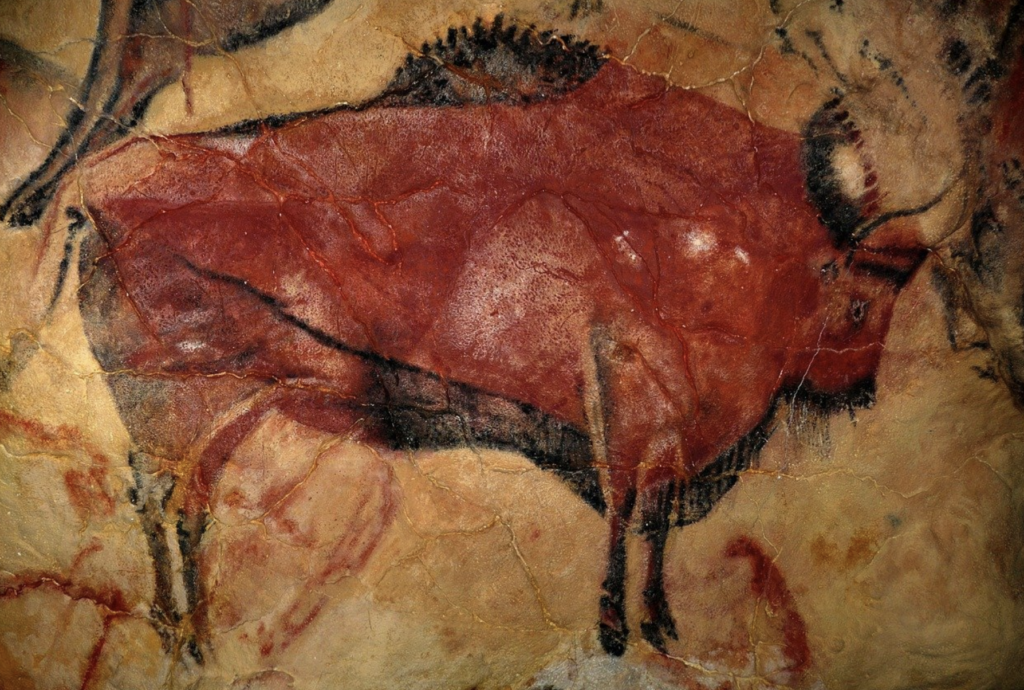
The Red Ochre Art of Cueva Del Castillo proves that Homo Sapiens Sapiens (that’s modern man, to you and me) was mixing pigments for millennia before putting them to canvas, and used natural materials such as iron ore, charred plant matter and ochre to create different earthy shades. The Cueva del Castillo (‘Cave of the Castle’) is an archaeological site within the Caves of Monte Castillo in Puente Viesgo in Cantabria, Spain, and it contains the oldest art known to man – a red dotted pattern in a cave painting. It was dated to around 40,000 years old by uranium-thorium dating in summer 2012, and sits at the centre of more red cave art in what we now call the ‘Panel de los Manos’. These are images of hands created by sucking up pigment through a reed or hollowed bone and using it to spray across a hand to create a reverse silhouetted image. The Cueva Del Castillo also contains detailed red ochre images of buffalo and other wild animals, and analysis of finger-stroke shape and size reveals that the artists were predominantly female.

Red Hair occupies a particular place in the works of the Victorian pre-Raphaelite painter Dante Gabriel Rossetti, whose subjects often looked into the realms of history and mythology and were often crowned with a halo of vibrant red hair and patterned after his long-suffering wife, the artist and poet Elizabeth Siddal. During the Georgian period, red hair wasn’t always in fashion, and had long been associated with a certain lack of morals (ridiculous), being a vampire (even more ridiculous), witchcraft (really?) and having a hot or fiery temper (actually, we’re beginning to see where this came from). People aren’t sure where the negative associations with red hair came from – some cite passages in the Bible that seem to imply that scheming Esau, who sold his brother for a bowl of stew, was red-headed; as was Lilith, the villainous first wife of Adam in Jewish mythology. Some people think that it’s simply a British-centric view that spread across the world that comes from the fear of invading Picts and Scots, who often had red or corn-gold hair. Through the pre-Raphaelite brotherhood, red hair became even more enmeshed with the idea of myth and magic – but this time fashionably so, with women buying red wigs and dyeing their hair with saffron and henna, as red-headed women became seen as dangerous and desirable.
See also: Jolene by Dolly Parton.

Proudly part of the Empowering Tech group
Powered by squid.